





Injection Grouting Solutions for Concrete Repair
[edit] Introduction
Concrete is renowned for its durability, but even well-designed and properly constructed concrete structures can deteriorate over time. Continuous exposure to moisture, structural movement, overloading, poor workmanship, aggressive environmental conditions and ageing can gradually lead to cracking, water ingress and internal deterioration.
What begins as a minor crack can eventually develop into a significant structural problem if left untreated.
Many property owners assume that damaged concrete must be demolished or replaced. However, in many cases it can be repaired effectively using modern injection grouting techniques. Injection grouting has become a widely used repair method because it can seal cracks, reduce water ingress and, where appropriate materials and methods are used, restore continuity and improve the performance of damaged concrete without extensive structural disruption.
Whether the structure is reinforced concrete, a basement wall, industrial floor slab, retaining wall, bridge or water-retaining structure, professionally designed injection grouting can play an important role in repair and rehabilitation.
[edit] Why Do Concrete Structures Deteriorate?
Concrete deterioration rarely occurs overnight. It usually develops gradually as a result of multiple interacting factors.
[edit] Water Penetration
Water entering through cracks or construction joints is a major cause of deterioration. Persistent moisture can lead to corrosion of embedded steel reinforcement, freeze-thaw damage in susceptible climates and a reduction in long-term durability.
This commonly affects:
[edit] Structural Movement
Buildings naturally experience movement caused by loading, settlement, thermal expansion and contraction, creep, shrinkage and vibration. Over time, these movements can create cracks that compromise durability and allow water ingress.
[edit] Ageing of Reinforced Concrete Structures
Older reinforced concrete buildings may develop defects through prolonged exposure to weathering, carbonation, chloride ingress and other deterioration mechanisms. Without timely maintenance and repair, structural performance may decline.
[edit] Poor Concrete Quality
Honeycombing, voids, inadequate compaction or poor construction practices can create weak areas within concrete elements. These concealed defects may subsequently lead to cracking, leakage or reduced durability.
[edit] Why Traditional Concrete Repairs Often Fail
Many superficial repairs address only the visible symptoms rather than the underlying cause of deterioration.
Examples include:
- Filling surface cracks without treating deeper defects
- Applying external sealants that do not eliminate internal water pathways
- Carrying out localised patch repairs while leaving adjacent deterioration untreated
As a result, cracks and leaks may reappear after temporary repairs. Effective rehabilitation often requires addressing the problem within the concrete itself.
[edit] How Injection Grouting Repairs Concrete from Within
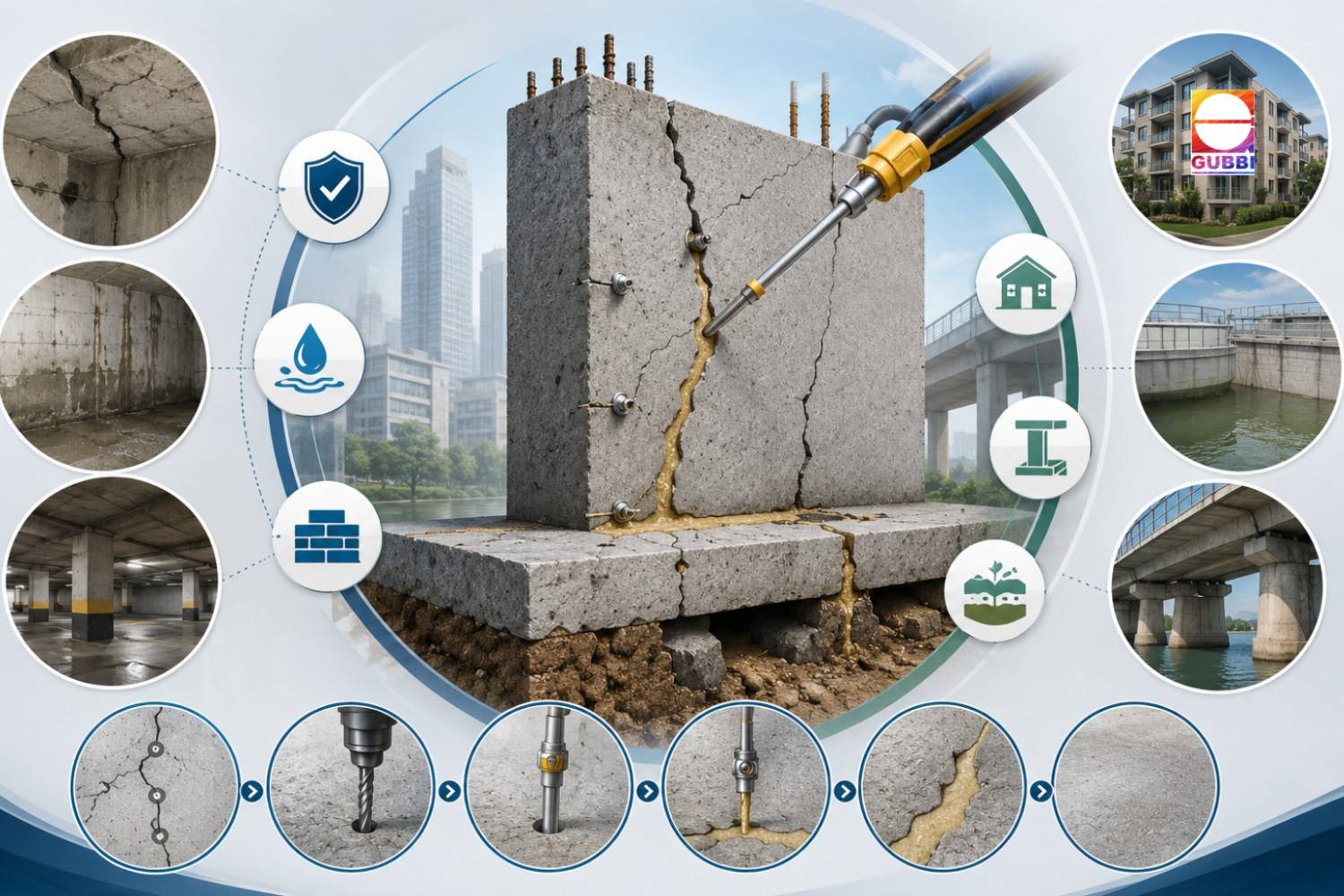
Unlike many conventional repair techniques, injection grouting introduces specialised repair materials directly into cracks, joints or voids within the structure.
Depending on the defect and the repair objective, materials such as epoxy resins, polyurethane resins or cementitious grouts may be selected. This approach can seal leaks, restore continuity across cracks or fill internal voids while minimising disruption to the structure.
[edit] Deep Crack Repair
Many concrete cracks extend significantly deeper than their visible surface width suggests. Injection grouting can penetrate these internal fissures and, where appropriate, help restore continuity and improve durability.
Typical applications include:
[edit] Controlling Water Ingress
Water penetration becomes particularly problematic when it reaches reinforcing steel, increasing the risk of corrosion and concrete spalling.
Injection grouting can seal internal leakage paths and is commonly used for:
- Basement waterproofing repairs
- Water tank leakage
- Underground structures
- Retaining walls affected by water ingress
[edit] Strengthening Defective Concrete
Where voids or cracks have reduced structural integrity, appropriate injection techniques may improve bonding and restore performance. However, the suitability of injection grouting for structural strengthening should always be assessed by a qualified engineer, as not all defects can be remedied by grouting alone.
[edit] Filling Hidden Voids
Internal voids and honeycombing may not be visible externally but can reduce durability and performance. Carefully specified grouting can fill these cavities and improve the integrity of affected sections.
[edit] Common Applications of Injection Grouting
Injection grouting is used across a wide variety of repair and rehabilitation projects.
[edit] Residential Buildings
Cracks, dampness and water ingress can often be repaired without extensive demolition.
[edit] Commercial Buildings
Targeted structural repairs can improve durability while reducing future maintenance requirements.
[edit] Industrial Facilities
Factories and warehouses frequently require repairs that minimise operational disruption while maintaining structural performance.
[edit] Bridges and Infrastructure
Injection grouting is commonly employed as part of maintenance and rehabilitation programmes for ageing infrastructure.
[edit] Water-Retaining Structures
Reservoirs, tanks and treatment facilities often use injection grouting to reduce leakage and improve watertightness.
[edit] Benefits of Injection Grouting
Injection grouting offers several potential advantages when properly specified and executed.
[edit] Reduced Structural Disruption
Major demolition or removal of sound concrete can often be avoided.
[edit] Faster Completion
Many grouting operations can be completed more quickly than extensive reconstruction works.
[edit] Improved Long-Term Performance
Addressing defects internally may reduce the recurrence of leakage or cracking.
[edit] Cost Savings
Repairing deterioration at an early stage is frequently more economical than replacing damaged structural elements.
[edit] Extended Service Life
Appropriate repairs and maintenance can help prolong the useful life of concrete structures.
[edit] Warning Signs That Should Not Be Ignored
Concrete repair should be investigated promptly if any of the following are observed:
- Expanding structural cracks
- Water seepage through walls or basements
- Persistent damp areas
- Spalling or crumbling concrete
- Honeycombing
- Settlement-related cracking or other indications of structural movement
Ignoring these issues may increase repair costs and compromise long-term performance.
[edit] The Importance of Professional Assessment
Concrete repair involves more than simply filling visible cracks. Successful rehabilitation depends on accurate diagnosis, appropriate material selection and a repair strategy suited to the nature of the defect.
A professional assessment may consider:
- The extent of structural damage
- Crack width, depth and movement characteristics
- Sources of water ingress
- Overall condition of the concrete
- Appropriate repair methods and materials
Selecting the correct repair approach helps maximise durability and long-term effectiveness.
[edit] Conclusion
Concrete deterioration should not be ignored, particularly where cracking, water ingress or structural defects begin to affect performance. Modern injection grouting techniques provide an effective means of repairing many forms of concrete damage while reducing the need for extensive demolition and helping to preserve existing structures.
Whether dealing with reinforced concrete cracking, leakage, voids or localised deterioration, timely intervention can improve durability, reduce future maintenance requirements and extend the service life of the structure.
[edit] Related articles on Designing Buildings
Featured articles
Check out some of the best features and news from Designing Buildings as well as key stories from around the web.

CIOB publishes free template to help assess and manage risks.
ECA's reflections on Party Conference season

Burnham wants to be confident of winning before asking for a fresh mandate.
New Chief Construction and Scientific Adviser

Sergio Cavalaro, Professor of Infrastructure Systems at Loughborough University.
Building safety levy for England

CIAT publish estimator tool for members.

Water sector faces a growing crisis that could slow the delivery of vital infrastructure.
Undervaluing our industrial past

Heritage value changes as taste for building styles changes.
Changing expectations around competence and compliance

New information sheet from CIAT.
Grenfell investigation files passed to CPS

Angela Rayner apologises on behalf of the British state.

Electrical contractors need to understand the practical implications.

The real barrier to getting more value from digital technology.

Your guide to The Construction Reset at UKCW Birmingham.

Accommodating the Victorian and Edwardian working woman. Book review.